

Two coins. Same date, same denomination, same design. One is graded AU-58. The other is described as BU. The price difference between them can be significant—and if you’re unfamiliar with those terms, it may not be obvious which represents the better value.
For collectors at any experience level, understanding the difference between About Uncirculated (AU) and Brilliant Uncirculated (BU) coins is one of the most practical grading fundamentals. AU coins show slight traces of wear from limited circulation, while BU is a market term generally referring to uncirculated coins in Mint State condition (MS-60 and above). These distinctions can meaningfully affect a coin’s value, appearance, and overall collector appeal.
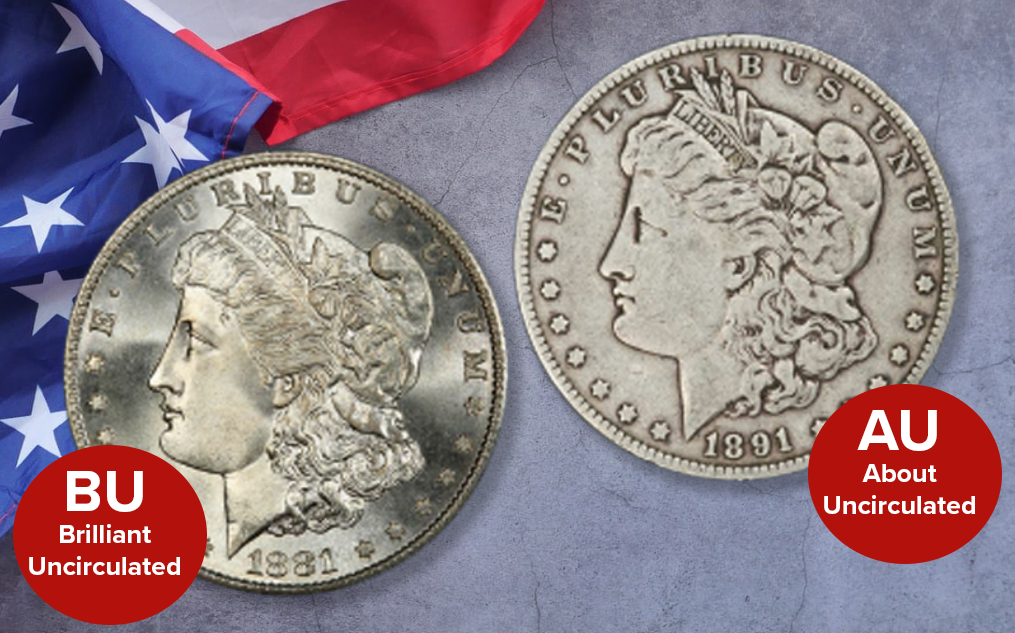
The Sheldon Scale: Where AU and BU Fall
The Sheldon Scale is the standard 70-point coin grading system developed by Dr. William Sheldon in 1949 and later adopted by third-party grading services such as PCGS and NGC as the modern industry standard. Our introduction to coin grading covers the full scale, but here is where AU and Mint State (MS) coins fall.
- AU (About Uncirculated): Grades 50–58
Coins in this range show light wear from limited circulation, with the most noticeable friction appearing on the highest points of the design.
- MS (Mint State) / BU (Brilliant Uncirculated): Grades 60–70
Mint State coins show no wear from circulation. Any marks present are the result of contact during the minting, handling, or storage process rather than actual use in commerce. BU is a market term commonly used to describe uncirculated Mint State coins.
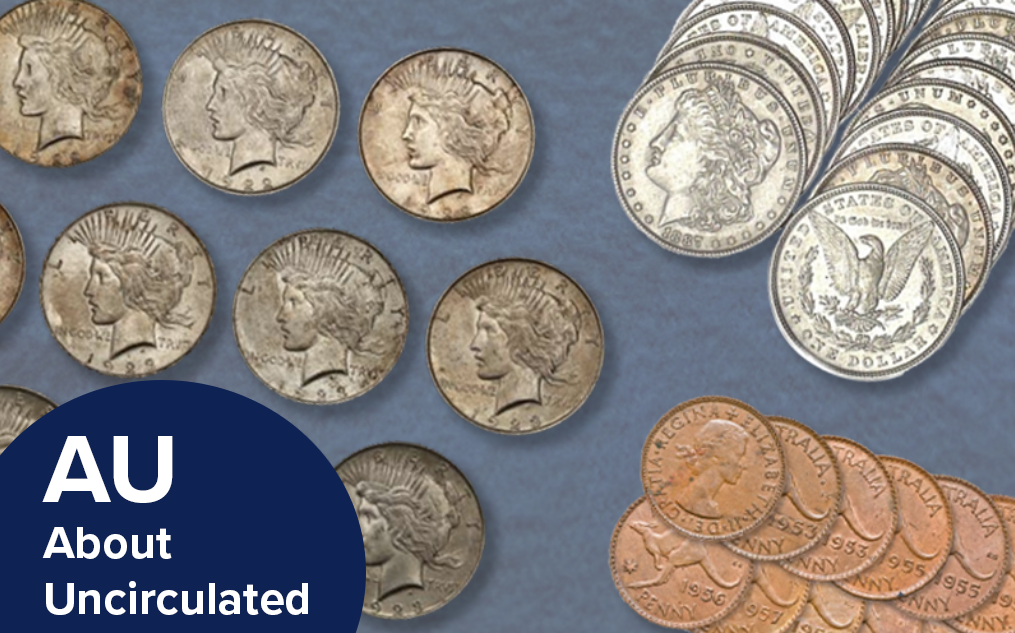
What Is an AU (About Uncirculated) Coin?
An About Uncirculated coin is exactly what the name suggests: it came very close to being uncirculated but shows slight evidence of brief circulation. AU coins have typically entered circulation for a short period, resulting in light wear that is confined to the highest points of the design, while still retaining most of their original mint luster. In higher grades, AU coins can be exceptionally attractive, and a novice collector may easily mistake an AU-58 for a Mint State example.
There are three primary AU grades on the Sheldon Scale, each reflecting increasing levels of wear and decreasing levels of remaining luster:
- AU-50: Light to moderate wear is visible on the highest design points. Portions of the original mint luster remain, but are noticeably diminished.
- AU-55: Light wear is limited primarily to high points, with most of the original luster still present. The coin can appear very close to Mint State at first glance.
- AU-58: The highest AU grade. Only the slightest traces of wear are visible, typically confined to the highest points of the design. Most of the original luster remains, and AU-58 coins are often highly attractive and sometimes comparable in eye appeal to lower Mint State examples.
When evaluating an AU coin, collectors look for “rub,” which is a smoothing or break in luster caused by friction on high points. On portrait designs, this is most often seen on the hair, cheeks, and ears, while on eagle reverses, it commonly appears on the breast feathers and wing tips. The presence of true wear at these points is what distinguishes an AU coin from Mint State.
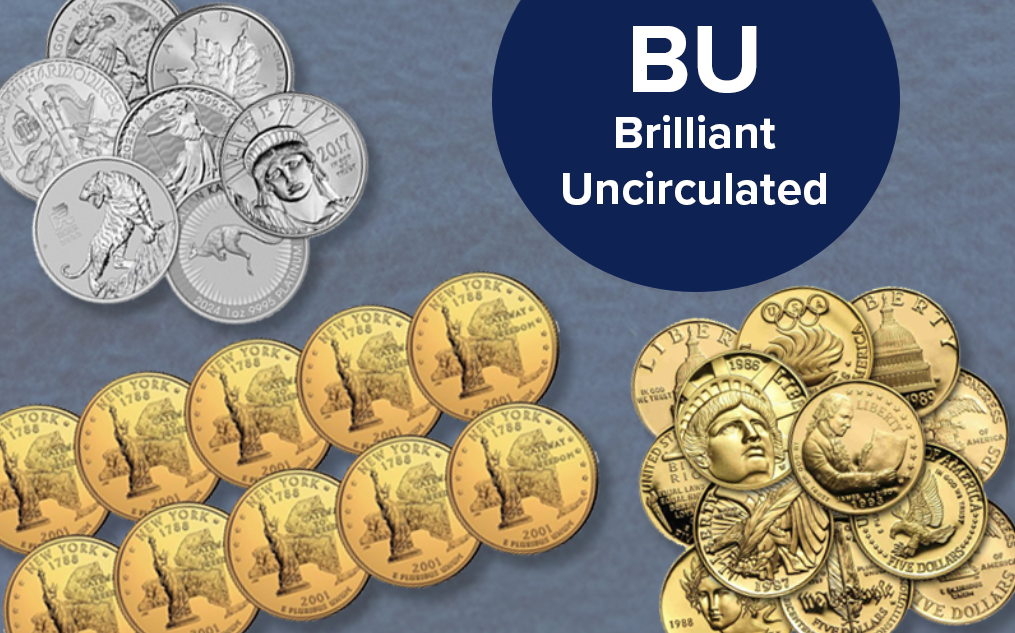
What Is a BU (Brilliant Uncirculated) Coin?
A BU coin, formally classified as Mint State (MS) by professional grading services such as PCGS and NGC, has never entered circulation and shows no wear from use in commerce. Instead of circulating as pocket change, it typically moves directly from the mint into storage, bags, tubes, or collector holdings.
Because of this handling, BU coins often exhibit contact marks, commonly referred to as “bag marks,” which occur when coins strike one another during bulk storage or transportation. These marks are not considered wear, but they do influence the coin’s numeric grade within the Mint State scale.
The BU/MS range spans grades MS-60 through MS-70, with significant variation in quality:
- MS-60: The lowest Mint State grade. The coin shows no wear but may have heavy contact marks, weak strike quality, and subdued luster. It is technically uncirculated but typically not highly attractive.
- MS-63: A typical mid-range Mint State coin with moderate contact marks, good luster, and an acceptable strike. Eye appeal is solid but not exceptional.
- MS-65: A Gem-level coin with strong luster, sharp strike, and only minor, non-distracting imperfections.
- MS-70: The highest Mint State grade, indicating a coin with no post-production imperfections visible under standard 5x magnification. These coins exhibit full luster and exceptional eye appeal and are among the most conditionally rare.
In general market usage, “BU” is an informal term used to describe uncirculated coins that appear to fall within the Mint State range. In certified numismatics, however, coins are assigned a specific MS grade rather than being labeled BU.
AU vs. BU: Key Differences at a Glance
- Wear: AU coins show minor wear on the highest points of the design, while BU/Mint State coins show no wear from circulation.
- Luster: BU coins typically retain full original mint luster. AU coins retain most of their luster but show breaks where light wear has occurred.
- Marks: BU coins may display contact or “bag” marks from mint handling and storage, while AU coins show actual rub from limited circulation.
- Grade range: AU spans 50–58 on the Sheldon Scale, while BU/Mint State spans 60–70.
- Price: BU coins generally command higher prices than comparable AU examples, though strong AU-58 coins or scarce dates can sometimes approach or exceed lower Mint State values.
Find AU and BU Coins at ModernCoinMart
Whether you’re building a type set with sharp AU examples or hunting for gem Mint State coins at the top of the grading scale, ModernCoinMart offers one of the most comprehensive inventories of certified and uncertified U.S. coins available online. Browse our U.S. silver coins to find pieces across all grades, or explore our full selection of graded coins to find exactly the quality level that fits your collection and budget.
Frequently Asked Questions: AU vs. BU Coins
Is a BU coin always worth more than an AU coin?
Not necessarily. While Mint State (BU) coins are generally valued higher than AU coins of the same type and date, a high-end AU-58 coin can sometimes be more valuable than a lower Mint State coin, such as MS-60 or MS-61. This is especially true when the AU coin has superior eye appeal, stronger strike, and better overall luster than the low-end Mint State example.
What does “rub” mean in coin grading?
Rub is a numismatic term used to describe light, shallow wear caused by friction during circulation. It typically appears on the highest points of a coin’s design, such as the hair, cheek, and ear on portrait coins, or the breast feathers and high relief areas on eagle reverses.
The presence of true rub indicates that a coin has experienced circulation wear, which generally results in it being classified as About Uncirculated (AU) rather than Mint State, regardless of how minimal the wear may be.
What is the difference between BU and Mint State?
Brilliant Uncirculated (BU) is an informal industry term used to describe a coin that shows no wear and retains its original mint luster. Mint State (MS) is the formal grading designation used by professional certification services such as PCGS and NGC, covering the numeric range from MS-60 to MS-70.
While the terms are often used interchangeably in the marketplace, Mint State is the precise technical classification, whereas BU is a broader, less specific descriptor for uncirculated coins that have not been formally graded.