

Pick up any coin from your pocket, and you’re holding more history than you might realize. The portrait on the front, the eagle on the back, and the Latin motto encircling the rim were all conventions not invented by the U.S. Mint. They were inherited, consciously and deliberately, from the coinage traditions of ancient Greece and Rome. When America’s founders designed the nation’s first coins in the 1790s, they had millennia of numismatic precedent to draw from, and they used it. Here’s a look at the ancient design traditions that still shape every coin in circulation today.
The Portrait Tradition: From Greek City-States to American Presidents
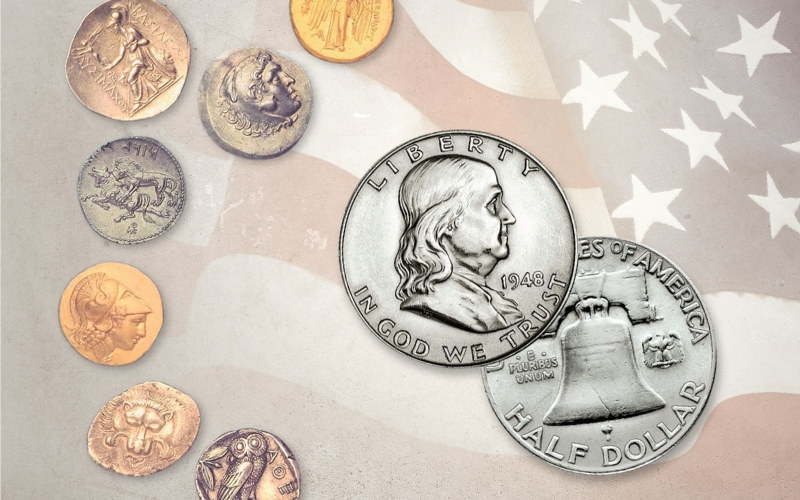
One of the most enduring conventions in Western coinage—placing a portrait on the obverse of a coin—can be traced to the ancient Greek world and later refined by Rome. Beginning in the 5th century BCE, Greek city-states frequently depicted gods, goddesses, and mythological figures on their coinage. Athens’ famous silver tetradrachm carried the helmeted profile of Athena, while Syracuse minted celebrated images of the nymph Arethusa. These were not merely decorative choices; they projected civic identity and connected a city’s authority to the divine.
Rome took the idea further and made it personal. Julius Caesar became one of the first Romans to place his own living portrait on a coin, a bold political statement that asserted authority and legitimacy. Subsequent emperors followed suit, transforming coinage into a powerful form of mass communication. Coins bearing an emperor’s likeness served as government-issued reminders of who held power across the empire.
That same visual tradition still influences U.S. coin design today. Portraits of Lincoln on the cent, Jefferson on the nickel, Roosevelt on the dime, and Washington on the quarter reflect a broader Greco-Roman tradition of using recognizable figures to symbolize authority, national identity, and shared values. Even early U.S. coinage—which favored allegorical depictions of Liberty instead of living leaders as a deliberate rejection of monarchy—retained the profile portrait format inherited from classical antiquity.
The Eagle: Rome’s Symbol on Every American Coin
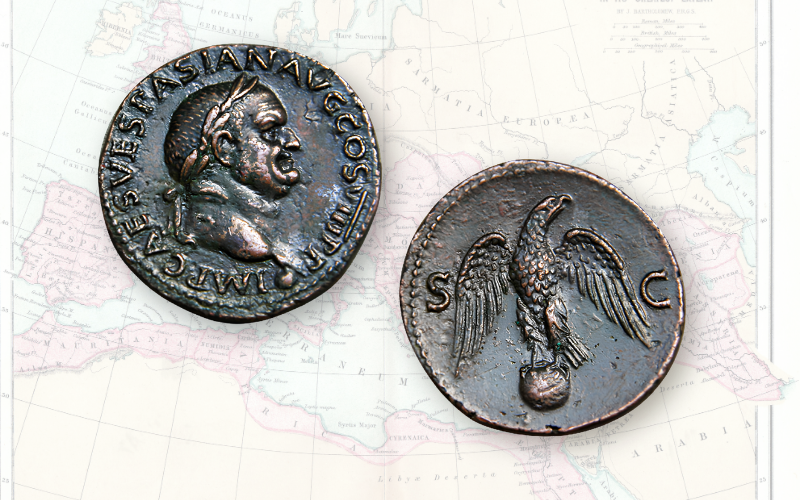
Turn over many U.S. coins, and you’re likely to find an eagle. The eagle—often shown with wings spread, arrows in one talon and an olive branch in the other—has become one of the most enduring symbols in American numismatics. Its imagery draws heavily from classical traditions, particularly Rome, while also reflecting uniquely American ideals.
In the Roman world, the eagle served as a powerful symbol of authority and military strength, appearing on standards carried by Roman legions and on imperial coinage throughout the empire. Roman coins frequently depicted an eagle perched on a thunderbolt, symbolizing the divine power of Jupiter. When the founders of the United States adopted the Great Seal in 1782 and later incorporated eagle imagery into coinage, they embraced a symbol that reflected both republican ideals and national strength, reimagined through the distinctly American bald eagle.
This tradition continues across many of the nation’s most recognizable coins. Earlier issues of the American Silver Eagle featured a heraldic eagle reverse inspired by the Great Seal, while the modern American Gold Eagle pairs Augustus Saint-Gaudens’ Liberty design with imagery rooted in classical artistic traditions. Together, these designs reflect the lasting influence of antiquity on American coinage.
The Obverse and Reverse: A Greek Convention That Endures
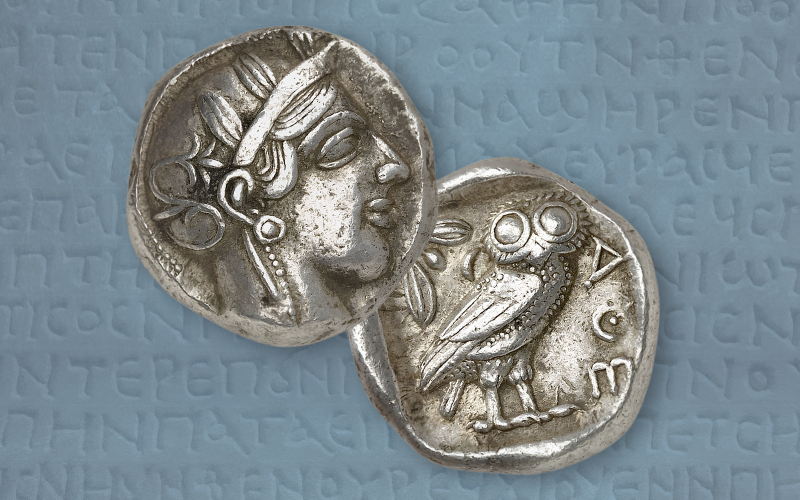
The idea that a coin carries distinct imagery on each side—what numismatists call the obverse and reverse—was refined in the ancient Greek world and remains central to coin design today. Greek city-states helped establish enduring conventions in which one side often featured a deity, ruler, or civic emblem, while the other carried symbols, animals, or scenes tied to local identity.
Athens’ famous silver tetradrachms paired the helmeted profile of Athena with her sacred owl. Corinthian coinage prominently featured Pegasus, while Syracuse became known for intricate reverse scenes depicting chariot races. These images were not merely decorative; they communicated civic pride, religious affiliation, and political identity to anyone who handled the coin.
Modern coinage continues this tradition. The Buffalo nickel’s reverse bison, commemorative quarter designs, and the changing imagery found across American coinage all use the reverse side to tell a story, symbolize national values, or reflect historical themes—an artistic convention with roots in the ancient Mediterranean world.
Explore U.S. Coins and Their Ancient Roots at ModernCoinMart
U.S. coinage reflects a tradition that stretches back more than 2,500 years, drawing inspiration from the artistic and symbolic conventions of ancient Greece and Rome. Whether you’re interested in modern bullion coins that carry classical design influences or historical issues that shaped the hobby, ModernCoinMart offers a wide selection of U.S. coins and collecting resources.
Browse our U.S. silver coins, explore American Silver Eagles, or visit our resource center to learn more about classic U.S. coin types and the history behind their designs.
Frequently Asked Questions: Ancient Coins and Modern U.S. Design
Did the Founding Fathers intentionally model U.S. coins on ancient coinage?
In many ways, yes—though often indirectly. The founders of the United States were deeply influenced by the political ideals and artistic traditions of ancient Greece and Rome, which shaped early American symbolism and design. That classical influence can be seen in elements of U.S. coinage, including profile portrait formats, Latin mottos, and eagle imagery inspired in part by Roman symbolism and republican ideals.
At the same time, early U.S. coin designs were filtered through Enlightenment and European artistic traditions. Rather than depicting living rulers, as Roman emperors often did, early American coins prominently featured Liberty, reflecting the young nation’s deliberate rejection of monarchy.
Where does “E Pluribus Unum” come from?
The phrase E Pluribus Unum (“Out of many, one”) has classical Latin roots and was likely influenced by multiple sources familiar to the Founding Fathers. One commonly cited influence is The Gentleman’s Magazine, a popular publication read in colonial America that used the phrase on its masthead to symbolize many sources brought together into one publication. Some scholars have also noted similarities to lines found in classical Latin literature, though no direct origin has been definitively established.
The motto was proposed during the creation of the Great Seal of the United States in 1776 and officially adopted in 1782. It later appeared on early U.S. coinage and became a longstanding feature of American money, symbolizing the union of many states into one nation.
Why does the U.S. use an eagle on its coins?
The bald eagle became a national symbol of the United States in 1782, when the Great Seal was adopted, chosen to represent strength, independence, and national identity. Eagle imagery later became a prominent feature of American coinage, appearing on many reverses as a symbol of the nation.
While the American eagle is closely associated with the bald eagle, its use also reflects broader artistic and symbolic traditions. Ancient Rome frequently used eagle imagery on military standards and coinage as a symbol of authority and power, often associated with Jupiter. American coin designers drew from these classical traditions, along with European heraldry, while reinterpreting the eagle as a uniquely American emblem.