

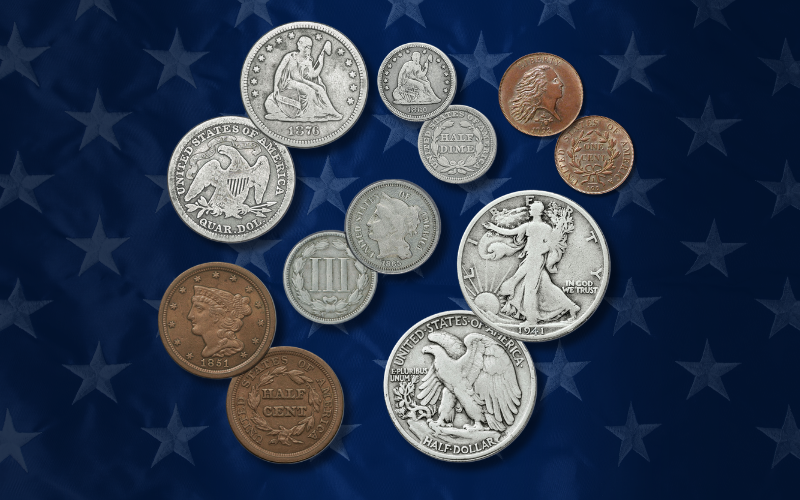
She has appeared with flowing, windblown hair, seated in quiet dignity, draped in the American flag, and striding confidently toward the sunrise. For generations, Liberty has been one of the most enduring figures in American coin design. Rooted in the classical ideals associated with the ancient Roman goddess Libertas, Lady Liberty represents freedom, independence, and the principles on which the young republic was founded.
When the United States established its national coinage in the 1790s, its leaders chose to portray Liberty rather than a sitting president. The decision helped distinguish the new nation’s coins from the royal portraits commonly found on European currency and placed an ideal at the center of American money. Over the centuries, artists reimagined Liberty to reflect changing ideas about the nation’s identity, aspirations, and place in the world. Her story offers collectors a fascinating way to explore American history through coinage.
Why Liberty and Not a President?
The Coinage Act of 1792, which established the U.S. Mint and laid the foundation for the nation’s federal coinage, required each coin to bear “an impression emblematic of liberty.” Rather than portray a sitting president, lawmakers chose Liberty, an allegorical figure representing the ideals of freedom and independence that defined the new republic.
George Washington reportedly opposed placing his own portrait on American coins, believing the practice too closely resembled the monarchies the United States had rejected. Instead, Liberty became a defining symbol of the nation’s early coinage, offering a contrast to the royal portraits common on British and other European coins.
That tradition gradually changed in the 20th century. Abraham Lincoln became the first president featured on a regular U.S. circulating coin when his portrait appeared on the cent in 1909. Presidential portraits later replaced Liberty on other denominations, and 1947 marked Liberty’s final appearance on a circulating U.S. coin: the Walking Liberty Half Dollar.
Lady Liberty Through the Ages
Flowing Hair (1793)
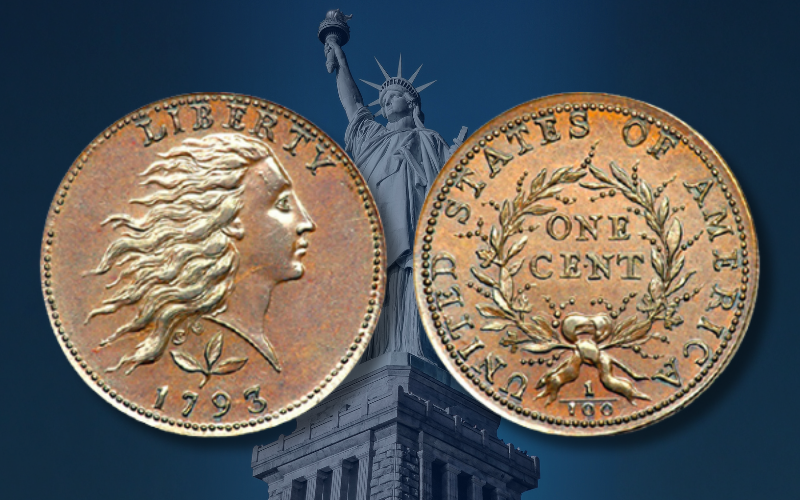
One of the earliest and most distinctive portrayals of Liberty appeared on the 1793 Flowing Hair cent. Its youthful portrait featured unbound hair streaming behind her, a design that proved controversial among the public. The first version, now known as the Chain cent, was the first regular-issue cent produced by the U.S. Mint. Its reverse displayed a chain of 15 links, intended to represent the unity of the 15 states in the Union. However, some critics viewed the chain as a symbol of bondage, while others objected to Liberty’s unrestrained appearance.
The Mint responded by replacing the chain with a wreath later in 1793, while retaining the Flowing Hair portrait. These early design changes reflect the challenges of establishing a national coinage that was both practical and symbolically meaningful. Today, the 1793 Flowing Hair cents remain important pieces of American numismatic history. Explore our guide to classic U.S. coins to learn more about early American coin designs.
Seated Liberty (1836–1891)
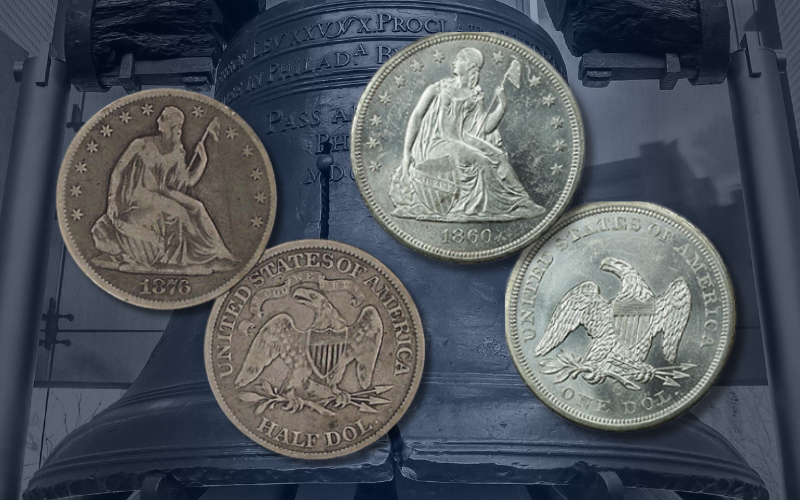
In the 1830s, Liberty underwent a striking transformation. Developed from artist Thomas Sully’s concept and engraved by Christian Gobrecht, the Seated Liberty design depicted a full-length figure seated on a rock, holding a shield inscribed with LIBERTY in one hand and a pole topped with a Liberty cap in the other. The imagery conveyed ideas of freedom, preparedness, and the protection of the young republic.
The design first appeared on silver dollar patterns in 1836 and was adopted for other silver denominations beginning in 1837. Over the following decades, it appeared on the half dime, dime, quarter, half dollar, and silver dollar, as well as the 20-cent piece introduced in 1875. Seated Liberty coinage spanned a period of profound change in American history, including westward expansion, the Mexican-American War, the Civil War, and Reconstruction. Although the silver dollar ended in 1873, other Seated Liberty denominations continued until 1891, making the design one of the longest-running motifs in 19th-century U.S. coinage.
- Key collecting note: Seated Liberty coins include multiple design subtypes, mint marks, and varieties across six denominations. Differences such as stars, arrows, drapery, and the addition of the motto IN GOD WE TRUST give collectors a wide range of issues to explore.
Liberty Head / Coronet (1838–1908)
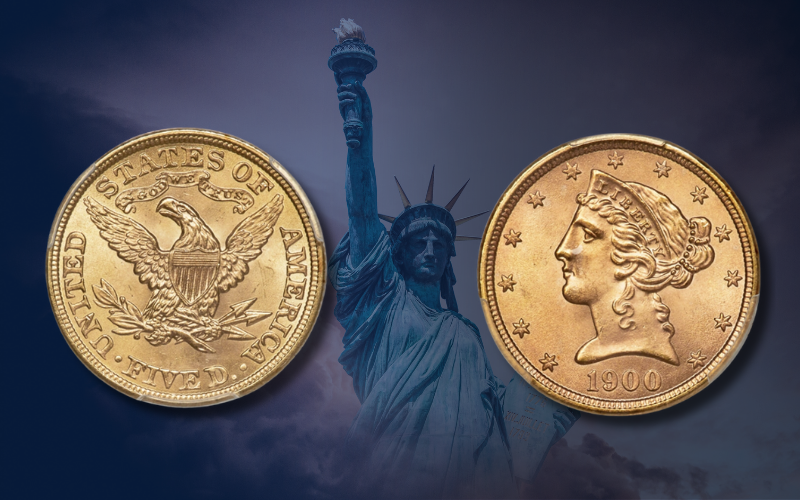
As American gold coinage expanded during the 19th century, Liberty took on a more formal appearance. The Liberty Head, also known as the Coronet design, depicted Liberty in profile wearing a coronet inscribed with LIBERTY. Christian Gobrecht created the design used on the $10 eagle in 1838, the $5 half eagle in 1839, and the $2.50 quarter eagle in 1840. James B. Longacre adapted the design for the $20 Double Eagle, first issued in 1849. These gold coins circulated during a period of westward expansion and mining booms, connecting the Liberty image to the economic growth of the American frontier.
A related Liberty portrait appeared on the copper Liberty Head large cent, minted from 1816 to 1857. Although it shared the broader neoclassical tradition of Liberty imagery, it was a distinct design from the Coronet gold coinage.
In 1916, sculptor Adolph A. Weinman introduced one of the most celebrated Liberty designs in American coinage: the Walking Liberty half dollar. Draped in the American flag, Liberty strides toward the sunrise with one arm extended and branches in the other hand. The half dollar was minted through 1947, making it the last circulating U.S. coin to feature Liberty before the design gave way to Benjamin Franklin’s portrait in 1948.
Nearly four decades later, the U.S. Mint revived Weinman’s Walking Liberty for the obverse of the American Silver Eagle, launched in 1986. The design remains a defining feature of the series, with a 2021 refresh restoring additional details from Weinman’s original artwork. Through the Silver Eagle program, Walking Liberty has reached generations of collectors and bullion coin enthusiasts, ensuring that this classic image continues to shape the story of Liberty on American coinage.
Frequently Asked Questions About Lady Liberty on U.S. Coins
Why did the U.S. stop putting Lady Liberty on coins?
Beginning in 1909, when Abraham Lincoln’s portrait replaced Liberty on the cent, U.S. circulating coin designs increasingly shifted toward portraits of presidents and other influential Americans. The change happened gradually as new designs were introduced for individual denominations, reflecting a growing tradition of honoring the people who helped shape the nation.
Liberty’s final appearance on a circulating U.S. coin came in 1947, the last year the Walking Liberty Half Dollar was produced. In 1948, Benjamin Franklin’s portrait replaced Liberty on the half dollar, marking the end of a tradition that had lasted more than 150 years on American circulating coinage.
Although Liberty no longer appears on regular circulating coin designs, she remains an important symbol on modern U.S. bullion coins. The American Silver Eagle features Adolph A. Weinman’s Walking Liberty design, while the American Gold Eagle uses Augustus Saint-Gaudens’ iconic depiction of Liberty. Both programs launched in 1986 and continue the tradition of representing American ideals through coin design.
Is the figure on the Mercury Dime actually Mercury?
No. Despite its familiar nickname, the Mercury Dime does not depict the Roman god Mercury. Officially known as the Winged Liberty Head Dime, the coin features Liberty wearing a winged Phrygian cap. The wings symbolize freedom of thought, reflecting the ideals represented by Liberty on American coinage.
Designed by Adolph A. Weinman and first issued in 1916, the dime earned its popular nickname because Liberty’s winged cap resembles the headgear associated with Mercury, the Roman messenger god. The design is part of Weinman’s lasting legacy in American numismatics, alongside his iconic Walking Liberty Half Dollar, introduced in the same year. Both designs remain celebrated examples of early 20th-century American coin artistry.
What is the most valuable Lady Liberty coin?
One of the most valuable coins featuring Lady Liberty is the 1933 Saint-Gaudens Double Eagle, designed by sculptor Augustus Saint-Gaudens. Depicting Liberty striding forward with a torch and olive branch, this iconic $20 gold coin sold for $18,872,250 at auction in 2021, setting a record for the highest price ever paid for a coin at public auction. The example sold is also exceptional because it is the only 1933 Double Eagle authorized for private ownership.
For collectors exploring more attainable Liberty designs, certain Seated Liberty and Liberty Head gold coins can carry significant numismatic premiums depending on their date, mint mark, condition, rarity, and demand. Professional grading and certification can help buyers assess a coin’s authenticity and condition. Learn more in our guide to why you should buy graded coins.
Explore Lady Liberty Coins at ModernCoinMart
From early American copper coins to the modern American Silver Eagle, Lady Liberty’s story on U.S. coinage spans more than two centuries of history, artistry, and national identity. Her evolving image reflects the ideals and aspirations of generations of Americans, making Liberty coins an enduring area of interest for collectors.
Explore ModernCoinMart’s selection of American Silver Eagles and U.S. silver coins to discover classic designs and modern issues that celebrate Liberty’s lasting legacy.